
Rumor vs Reality: Dispelling the Myths about “Cleantech” Stirling Engines
Off-grid power is challenging. We’re all so accustomed to ultra-reliable and unlimited grid power that selecting, operating and maintaining off-grid power is foreign to most of us. This article is being provided to compare and contrast two specific technologies: internal combustion engines and Stirling engines, which are a type of external combustion engines. Our analysis is for the 1-6kW range which is common in the energy industry for cathodic protection, pumps, compressors, lighting, communication and other small facility equipment. In particular, operational data and end user input is being summarized for Global Power Technologies’ MX Prime Power (6kVA) and a 5.6kW Stirling engine.
Internal combustion engines are highly familiar technology around the world and therein lies the reason for the many benefits that they provide. First, they are extremely fuel efficient due to the large number of automotive and other engine applications that have been improving and refining these engines since the 1800’s. Second, due to their proliferation in so many applications, they are highly familiar to many trained or even hobby technicians in virtually any region worldwide. Over 85 million cars powered by internal combustion engines are produced each year, providing excellent data for mean time to failure and predictive maintenance plans for excellent reliability for 10 or more years.
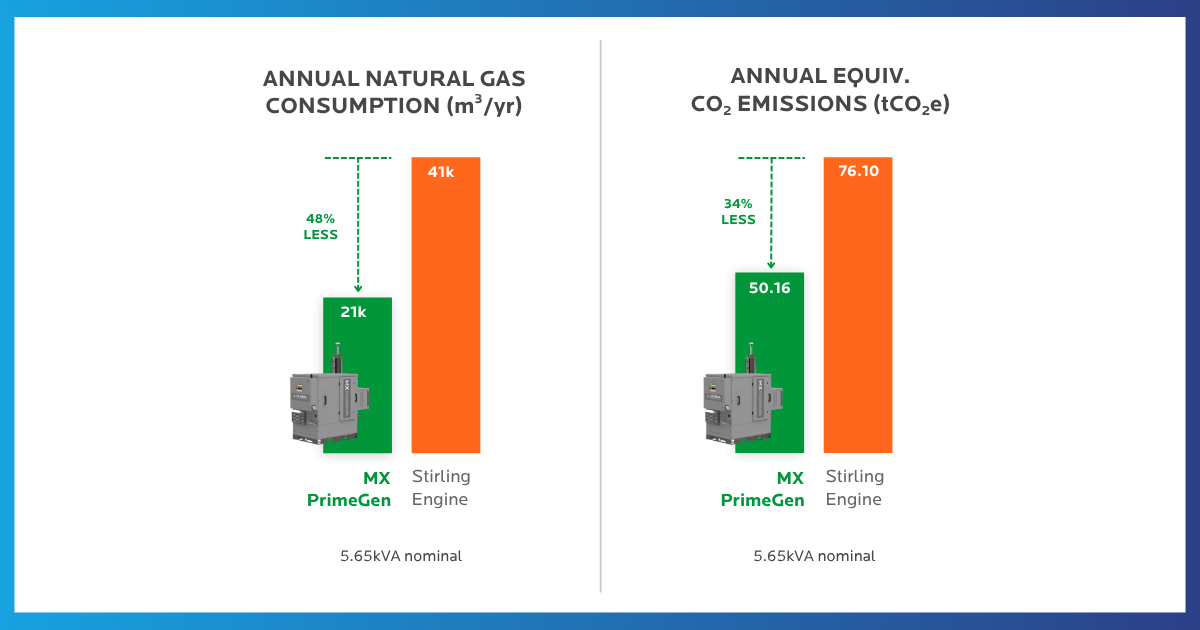
In contrast, while Stirling engine technology is not new, their commercial launch into off-grid power applications is relatively new. Their fuel to electrical efficiency (10%-12%) is roughly half that of internal combustion engines (22%-25%), meaning that for the same power output they require double the fuel intake. When providing 5.65kW of power, the Stirling engine consumes 112.25m3/d (3,964ft3/d) while the MX Primegen consumes 56.8m3/d (2,006 ft3/d). As the additional energy is lost to heat, it means that Stirling engines can offer more heat output at the same power output of an internal combustion engine, but with double the fuel, so these advantages may be lost for overall site efficiency or fuel use effectiveness. Stirling engines require specialist training for commissioning and service. In some cases, major components cannot be serviced in the field (or uneconomical to service even with the original manufacturer), and a full unit replacement may be necessary if a breakdown occurs. Industry is still assessing the true field reliability of these units, as many end users report failures occurring after approximately two years with little to no warning.
Field reports indicate that some Stirling engine units require replacement after approximately two years of operation, which can increase long-term maintenance costs for operators.
Stirling engines are often marketed as environmentally friendly or high efficiency alternatives. However, operational data for this application shows that modern internal combustion engines running on natural gas achieve higher fuel efficiency and lower emissions. As indicated above, the fuel efficiency of modern internal combustion engines running on natural gas is double that of Stirling engines in the same power range and fuel type. Similarly, the total emissions of internal combustion engines (50.2 tCO2e/yr) are significantly lower than that of Stirling engines (76.1 tCO2e/yr), and both technologies destroy more than 98% of methane content of the gas. The overall product life, local technician serviceability and quick time to resolve infrequent breakdowns are further reasons to demonstrate that internal combustion engines have the lowest impact on the planet with less equipment going to landfill, fewer long distance flights for specialized technicians, lower fuel consumption and lower emissions. Comparing the full effect of the product lifecycle is important before deciding which products are truly green.
MX clients continually rely on the efficiency and serviceability of our products to run predictable and affordable operations over the life of their assets. The unit has simple annual maintenance like oil, air filter and spark plug changes which can all be done locally. Many field operators with common tickets will already be familiar with the work. Using local labor provides significant savings when compared to bringing in specialized technicians, we estimate clients save up to $4500 per service call when factoring in the cost of flights, travel time, hotels and meals.
New clients are approaching us to evaluate switching technologies when their Stirling engines have issues in the field. They were often happy with the equipment in the first two years, but once a breakdown occurs they become frustrated with the time it takes for an expert to arrive and assess the problem, and are then surprised to learn when their unit can’t be serviced leading to a costly full replacement as the only possible solution.
The energy industry is under increasing pressure to operate with lower total cost over the life of their assets and to do so with higher efficiency and lower emissions. For all these reasons, the MX is the most fuel efficient, emissions conscious, field serviceable and longest product life solution available, even when compared to Stirling engines who claim to be newer and greener.