
Why total cost of ownership (TCO) now (more than ever?) favors natural gas over diesel gensets
Diesel prices hold well above 2025 levels
For operators running generators around the clock at remote sites, the first question is usually not which technology is newest. It's what the site will cost to keep running smoothly. Lately, more of our clients have been asking that question about diesel, and for good reason. U.S. retail diesel sold for roughly $3.50 to $3.80 per gallon through 2025, but by September 2026 it had climbed above $6.00.
Canadian operators are seeing the same pressure. Natural Resources Canada's weekly fuel survey put diesel above CAD $2.33 per liter, more than 60% higher than a year earlier, and prices have stayed above CAD $2.00 since March. Internationally, we see the same pricing trend, and some regions are not even sure they will be able to source the diesel they need.
At an off-grid site, the pump price is only part of the bill. Diesel must be trucked in, so higher fuel prices tend to raise delivery costs, too. Each refill costs more than the last, and over time that wears away the savings that made a low-cost genset attractive in the first place.
Every forecast scenario stays elevated
Some of that pressure may ease, but none of the forecasts we have reviewed show a return to 2025 prices. Agricultural Economics' September 2026 analysis, "The Diesel Forecast," models three supply scenarios. By September 2027, diesel reaches $6.33 per U.S. gallon if current supply disruptions continue, $4.56 in the intermediate case, and $3.92 if they resolve.
The same chart includes a futures-based projection of $4.94 and the U.S. Energy Information Administration's outlook of $4.11. Even the lowest of these endpoints sits above nearly every month of 2025.
That is why we test generator economics across the full range rather than picking one number. It lets our clients choose equipment without betting on a single forecast being right.
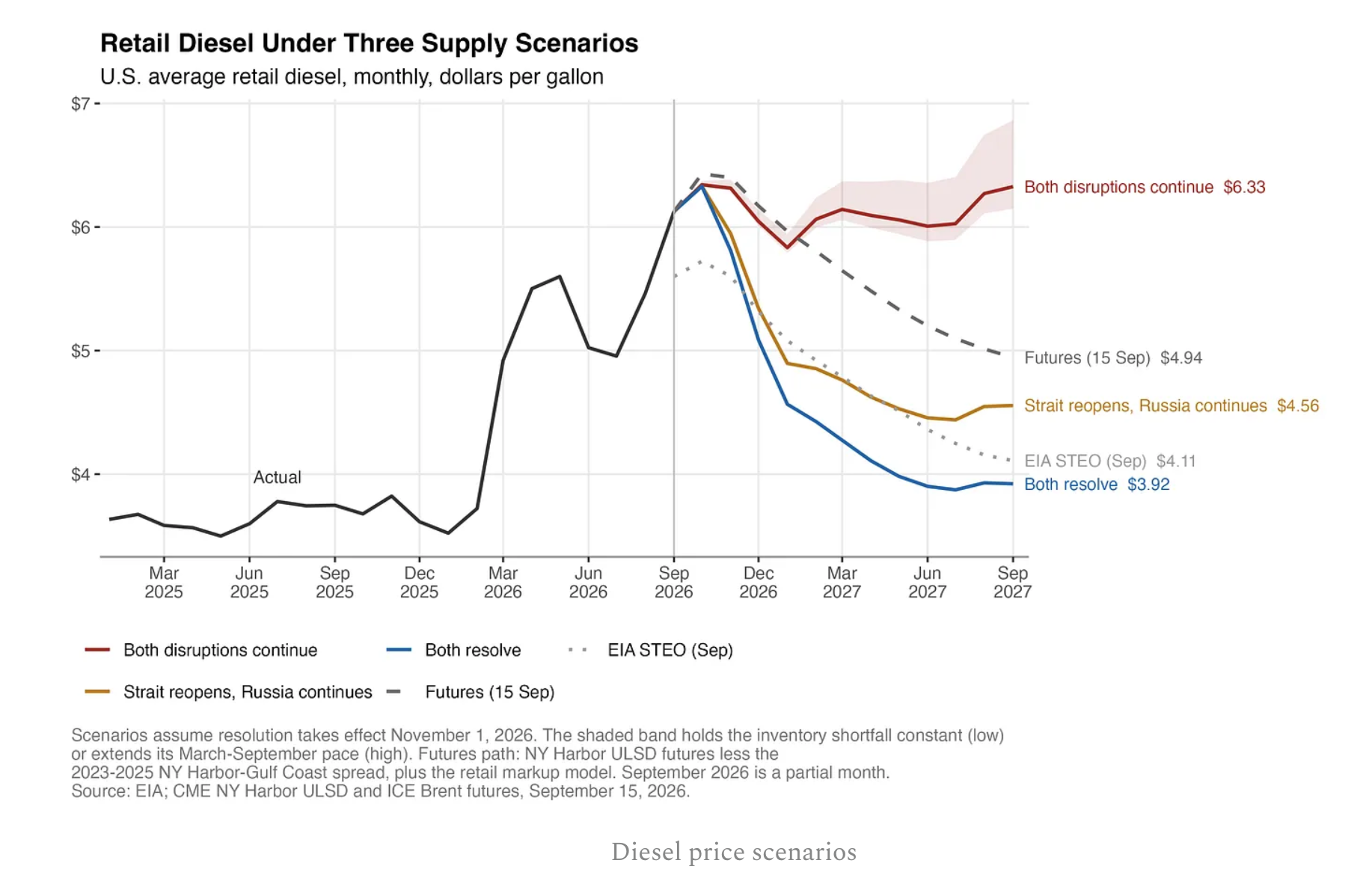
Source: Agricultural Economics, "The Diesel Forecast"; EIA, CME NY Harbor ULSD and ICE Brent futures, Sept. 15, 2026.
Where diesel gensets win, and where costs compound
Diesel still makes sense when you need power quickly or temporarily. The upfront cost is relatively low, fuel delivery networks are well established, and there is no natural gas connection to install.
Those advantages matter less once a temporary installation becomes a permanent power source. Fuel purchases continue month after month, and more frequent maintenance intervals add service costs no matter who pays the technician.
To better understand exactly when it makes sense to invest in permanent power solutions like Global Power Technologies MX natural gas generator, we built a total cost of ownership model comparing the two solutions.
The table below shows the major cost factors used in the model:
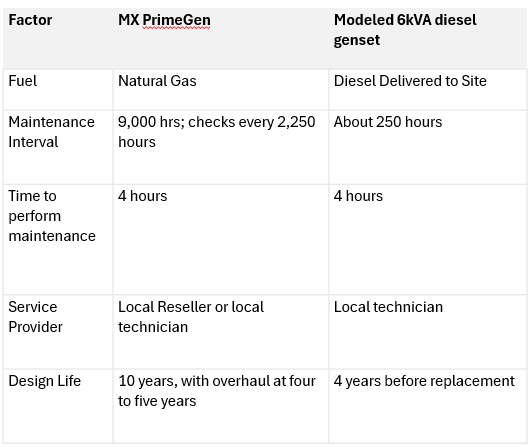
Source: Global Power Technologies. Differences between MX PrimeGen and diesel genset.
In our comparison, the 6 kVA diesel genset needs maintenance every 250 hours. At 8,760 hours of continuous operation a year, that works out to about 35 service visits annually, or roughly one every 10 days.
Each of those visits means site access, travel time, and a possible interruption to production. Over several years, maintenance and equipment replacement end up mattering as much to the purchase decision as the price on the quote.
The TCO crossover happens inside year one
We walked through these numbers in detail in a recent webinar on the total cost of ownership of the MX PrimeGen. Our model compares power technologies over 10 years and includes capital and replacement costs, downtime and lost production, maintenance, and fuel.
The MX PrimeGen costs more upfront than the modeled 6 kVA diesel genset, but its lower operating costs start paying back that difference right away. The diesel cost line passes the MX at about six months, which puts the modeled crossover well within the first year.
We also tested diesel prices 20% above and below our base assumption, and the year-one result held in both cases. So even if fuel prices fall, the MX is worth a close look. That said, a modeled payback is not a guarantee, and every site will land a little differently. Local labor rates, delivered fuel prices, and daily operating hours will affect the actual dollar savings for each specific project.
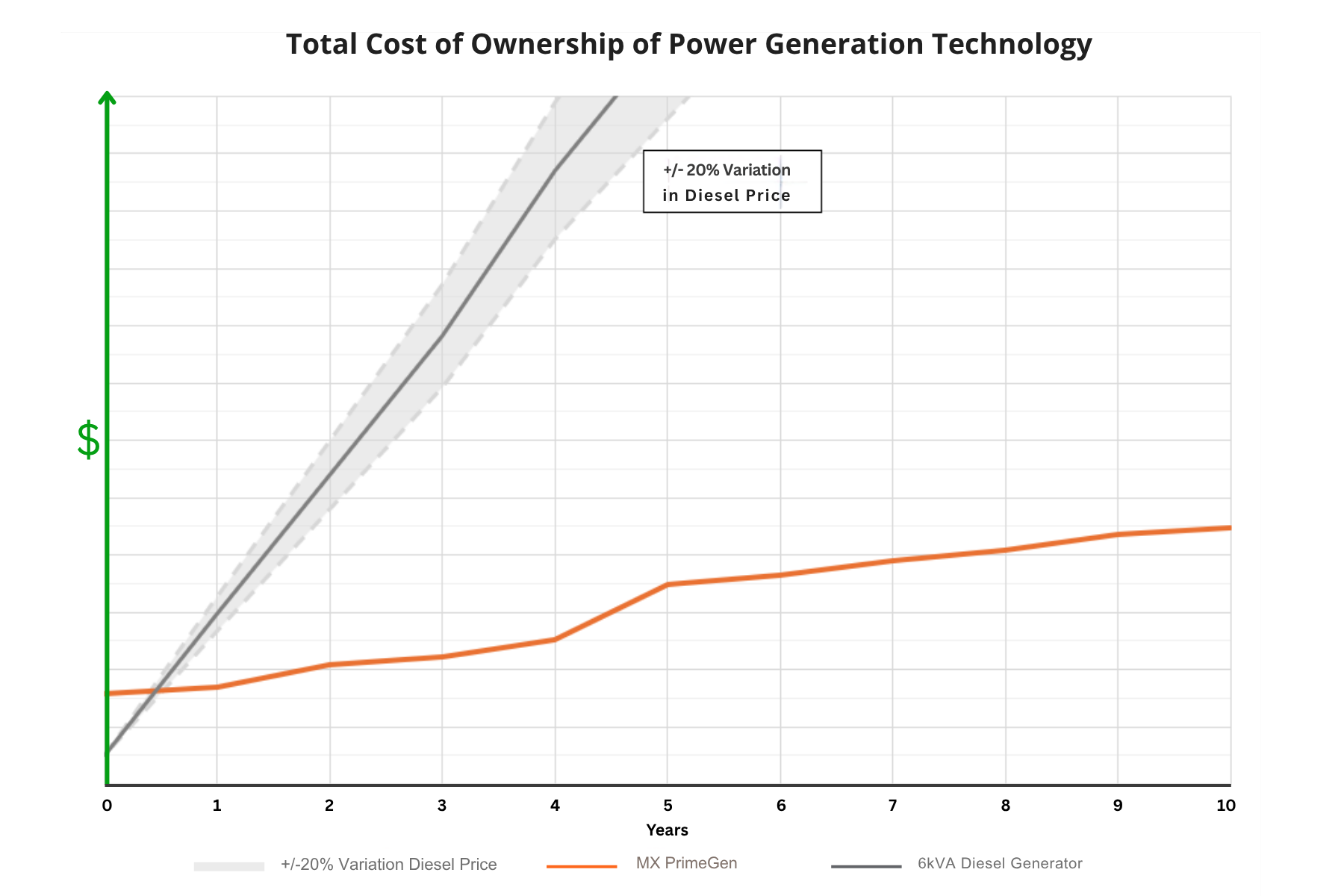
Source: Global Power Technologies. Crossover within year one; planned engine and alternator work around year five. Shading shows ±20% diesel-price variation.
Built for long-run unattended prime power
The savings on total cost of ownership come down to how we designed the MX PrimeGen: for long-run, unattended, fuel-efficient off-grid power. The 6 kVA generator can run continuously or cycle, and it follows the electrical load without needing a load bank.
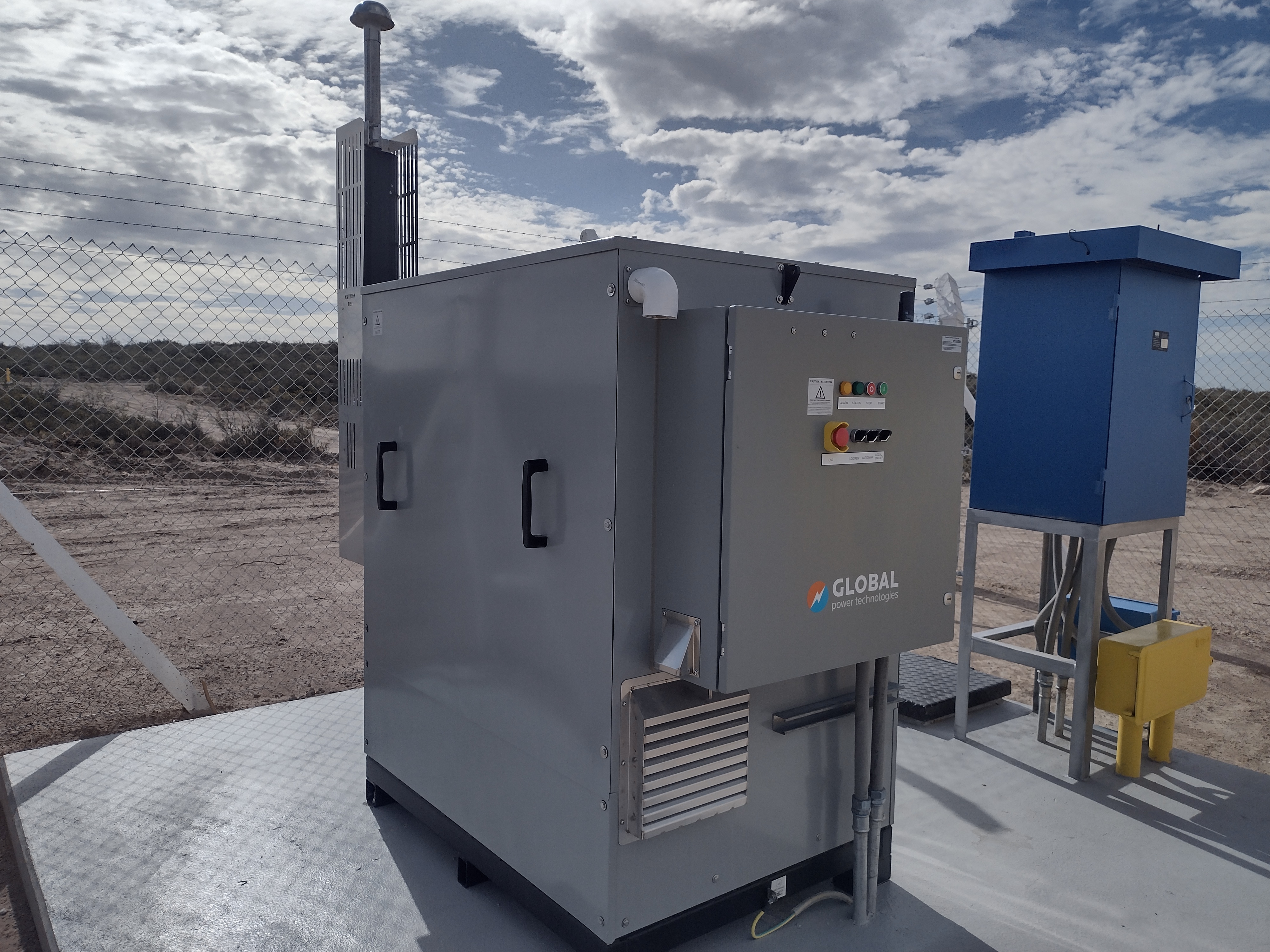
Its 9,000-hour maintenance interval works out to about one service a year under continuous operation. That service covers the engine oil, oil filter, and spark plugs, plus a valve-clearance adjustment, and takes two to four hours. Between services, we recommend checks every 2,250 hours to look at filters, fluid levels, and fuel supply.
You don't need a specialist for any of this. Our local resellers, or any mechanically inclined technician, can do the work. Planned engine and alternator servicing at four to five years then carries the unit to its 10-year design life.
Installation is just as practical. The unit is set by forklift or lifting rings on a solid, level, noncombustible base, and a gas fitter and electrician connect the fuel and electrical systems, with a half-inch tube union at the fuel inlet.
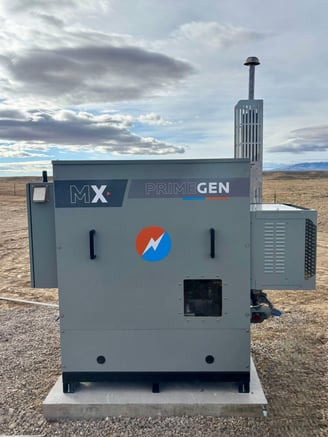
Source: Global Power Technologies. MX on the field.
Planning remote power for fuel uncertainty
Every site is different, so the evaluation should start with power load, available fuel, maintenance access, and lifetime operating costs. Product selection is never just about the purchase price.
For continuous remote power, the convenience of diesel up front has to be weighed against years of recurring expense. Where site conditions suit the MX, longer service intervals and lower operating costs make a practical case for natural gas prime power.
If you're weighing diesel against natural gas for a remote site, talk to our team about your power load and site conditions. We'll help you work out the most practical configuration before you commit to equipment.